
“Uncloaked”: Andrew Jenkins on The Traitors, Trauma, and the Power of Creativity
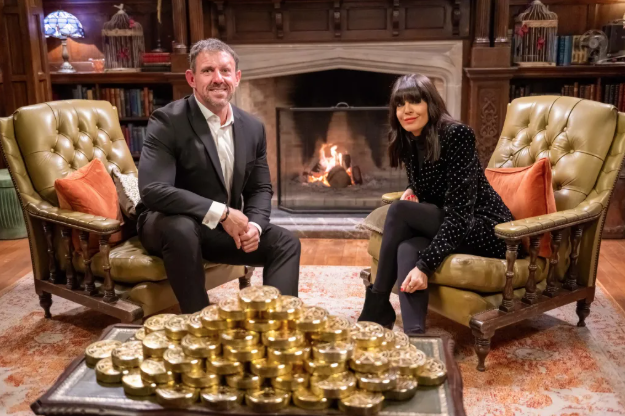
When Andrew Jenkins appeared as one of the cloak‑wearing villains in Series Two of The Traitors, viewers saw a man who could bluff, deceive, and strategise with the best of them. What they didn’t see was the story beneath the cloak — a story of survival, trauma, and a decades‑long journey back to himself.
On the very day we met, Arts Council Wales released a landmark Bangor University report showing that for every £1 invested in the arts, Wales receives £11.08 in health benefits — a finding that feels almost tailor‑made for Andrew’s next chapter. He is preparing to open a new Wellness Centre at the former Miskin Manor in Rhondda Cynon Taf, where creative and artistic sessions will sit alongside physical wellbeing and counselling support.
Our conversation — edited for clarity and readability — reveals a man who has rebuilt his life from the ground up, and who now wants to help others do the same.
Background
In 1999, Andrew was involved in a catastrophic road accident that left him clinically dead at the roadside for several minutes. He spent weeks in a coma, underwent major reconstructive surgery, and was told he would never walk again. He refused to accept that prognosis.
What followed was a long, private battle with trauma, identity, and mental health — one he hid behind a mask of normality for years. Today, he speaks openly about that journey in schools and organisations across the UK, using his experience to challenge stigma and encourage emotional honesty.
Listen to the Full Conversation at the Bottom of this Page
Q: Andrew, let’s start at the beginning. What happened in 1999 that changed everything for you?
Andrew: On 20 August 1999, I was in a serious road traffic accident. My car hit a kerb, flipped, and I was dragged along the road before the car landed on top of me. When the emergency services arrived, they were told I was dead. I’d stopped breathing for two or three minutes.
I was taken first to the Royal Gwent, then transferred to Morriston Hospital in Swansea for neurology and plastic surgery. I’d smashed my skull, lost all the skin and hair on the top of my head — I’d completely scalped myself. I spent four weeks in a coma, and my family were told several times I wouldn’t make it through the night.
When I did wake up, doctors said I’d never walk again. My first response was, “I guarantee I’ll walk out of this hospital.” And I did — two weeks later.
Q: The physical recovery was extraordinary, but you’ve said the mental health impact was even harder. How did that show up in your day‑to‑day life?
Andrew: Massively. Back then, mental health wasn’t spoken about, especially not in families like mine — very macho, very “don’t show emotion”. I refused counselling because I thought I’d be judged. I couldn’t talk to my family, so I put on a mask.
On the outside I had the job, the car, the clothes. Inside, I hated myself. I couldn’t accept my scarring. I thought I was ugly. I thought my family would be better off without me. I never acted on anything, but I wished I wasn’t here. Looking back, I was probably severely depressed.
I’d lie in bed staring at the ceiling, crying, unable to move. Then I’d drag myself up, put on a shirt and tie, and pretend everything was fine. Men do that a lot — hide everything.
Q: Do you think that’s a Welsh thing, a men thing, or a generational thing?
Andrew: A bit of all three. It is getting better, but men are still told from a young age: don’t cry, man up, don’t be soft. Then later in life, you don’t know how to express emotion, so it comes out as anger or frustration.
Girls are encouraged to cry. Boys aren’t. But there’s no difference. None at all.
Q: You now travel the country sharing your story. What impact does that have on people — and on you?
Andrew: It’s been amazing. I get messages every day. I especially love talking in schools because that’s where you can change culture. Kids need tools to deal with life — because life will throw challenges at them.
There’s this idea that children are resilient, but we don’t let them be. We wrap them in cotton wool. Resilience comes from living life, failing, trying again.
I call myself an educational speaker, not a keynote speaker. I want people to take something away they can use.
Q: We have to talk about The Traitors. How has being on such a huge show changed things for you?
Andrew: It’s been brilliant. I don’t really watch reality TV, but The Traitors is the one thing I do watch. Being part of it has given me a platform to show people that you can go through trauma and still achieve great things.
I used to let my trauma define me. Now I use it to help others. At a talk last week, people were crying and laughing — that’s what I want. I want them to feel something and see that their trauma, whatever it is, doesn’t have to hold them back.
Q: You mentioned earlier how important creativity and movement have been for you. What role do those things play in your wellbeing now?
Andrew: Huge. Anything creative — ceramics, art, walking, being outdoors — it all helps. Nobody’s coming to save us. You have to take ownership of your physical and mental health.
I did a walk‑and‑talk recently. Two men who’d worked next to each other for three years told each other things they’d never shared before. Walking side by side, in nature, in daylight — it’s powerful. It’s not confrontational. You just talk.
Q: And now you’re opening a Wellness Centre. Tell me about that.
Andrew: It’s something I thought would be five years away, but the opportunity came up eight weeks ago. The old Miskin Manor — a stunning place — had a wellness centre years ago. I’m turning it into a one‑stop shop for mind, body, and spirit.
There’ll be a gym, sauna, jacuzzi, breathwork, spiritual sessions, creative arts, dance, classrooms — everything. I want people to unplug from the world the moment they walk in. Waterfalls, greenery, calmness.
And we’ll have counsellors on site. Loads of people have told me they wouldn’t go to a counsellor’s office, but they would see someone if it was part of a wellness space. That’s powerful.
Q: When do you hope to open?
Andrew: June or July. I want it to be perfect — a place people want to spend the whole day. A community, not just a building.
Why This Matters Now
The timing of Andrew’s project feels significant. On the same day we spoke, Arts Council Wales published research showing the extraordinary health value of the arts — a reminder that creativity isn’t a luxury, but a lifeline.
Andrew’s Wellness Centre will bring that principle to life: a space where movement, creativity, conversation, and community sit side by side.
And with The Traitors finale approaching, audiences who watched Andrew scheme in a castle may soon see him in a very different light — not as a Traitor, but as a guide, a mentor, and a man determined to help others heal.